
Manufacturing, which has around 80 per cent weight in the Index of Industrial Production --a measure of factory output in the country -- rose by 17.9 per cent during the month against one per cent a year ago.

The IHS Markit India Services Business Activity Index stood at 5.4 in April, an extreme decline from 49.3 in March, and indicative of the most severe contraction in services output since records began in December 2005. As per the IHS Markit India Services Purchasing Managers' Index (PMI), a print above 50 means expansion, while a score below that denotes contraction.

The decline has been mainly on account of a fall in manufacturing, the output of which contracted by 3.3 per cent during March. The sector, which accounts for almost 80 per cent of the index, registered an increase of 5.7 per cent during the same month in 2008.
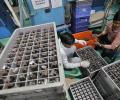
The new four-wheeler (4W) electric vehicle (EV) policy may spur the entry of global majors. The manufacturing policy cuts Customs duty to 15 per cent, given a minimum investment commitment. It calls for a minimum investment of Rs 4,150 crore (about $500 million) for making electric four wheelers (e-4Ws), with manufacturing to commence within three years of approval.

The department, which carries out a number of searches against other high income sectors like real estate, manufacturing and sales, has for the time put its scanner on the sector which accounts for about 45 per cent of the manufacturing output of the country.
"Purchasing managers' index for April has risen above the 50 mark to 53.3 suggesting industrial output expanded in sequential terms in April. Therefore, we continue to expect a recovery in manufacturing production in the months ahead," DBS Bank said. PMI gives an indication of the country's manufacturing activity and its future outlook.

The HSBC India Manufacturing Purchasing Managers' Index (PMI) - a measure of factory production - improved slightly to 55 in June, from 54.8 in May.
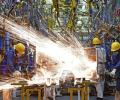
Capital goods, a barometer of investments, showed a sharp increase in output by 14.6 per cent in January, 2018 as against a decline of 0.6 per cent year ago.

The index of industrial production, which was negative in March, was positive in April - but just barely.

The Nikkei India Manufacturing Purchasing Managers Index (PMI), fell from 52.1 in February to a five-month low of 51.0 in March, indicating the slowest improvement in operating conditions recorded by the survey since last October.
Industrial output grows at meagre rate of one per cent in 2012-13 compared to 2.9 per cent in the previous fiscal.

Global markets trends, inflation, release of industrial output data and quarterly earnings will dictate movement of the equity benchmarks this week, analysts said, adding that volatility might continue amid slew of announcements of macroeconomic data at the global level too. Moreover, foreign fund movement, crude oil prices and trend in rupee would also act as major drivers for the equity market, they added. "The direction of global equity markets along with movement in dollar index and crude oil prices will continue to dominate while inflation numbers of the USA on May 11 and inflation and IIP numbers of India on May 12 will also cause volatility in the market," said Santosh Meena, head of research, Swastika Investmart Ltd.
India's industrial output rose 6.2 per cent in October year-on-year, boosted by strong growth in the manufacturing and electricity sectors, official data released on Thursday showed.
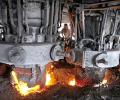
India's industrial output unexpectedly contracted 4.2 percent year-on-year in October, dragged down by a fall in the manufacturing and the capital goods sector, government data showed on Friday.

The seasonally adjusted India Services Business Activity Index rose sharply from 34.2 in July to 41.8 in August, the highest since March, before the escalation of the pandemic.

India's factory output climbed 22.4 per cent in March, benefiting from the base effect of the lockdown-marred month a year back as well as a turnaround in the manufacturing sector, while retail inflation slipped to a three-month low of 4.29 per cent in April. The high positive annual growth in the index of industrial production (IIP) in March 2021 came on back of a contraction of (-)0.9 per cent and (-)3.4 per cent in January and February 2021 respectively, according to the data released by the National Statistical Office (NSO) on Wednesday. This turnaround was led by recovery in the mining, manufacturing and electricity sectors.
The recovery in the Indian services sector was sustained in November as new work orders supported business activity growth and the first rise in employment in nine months, a monthly survey said on Thursday.

The HSBC/Markit Purchasing Managers Index for the services industry inched up to 47.2 in November from 47.1 in October, the fifth sub-50.0 reading and indicated an output contraction across the Indian service economy.

On a day like this, the market breadth was predictably strong. Out of 2,827 stocks traded on the BSE, there were 1,629 advancing stocks as against 1,105 declines.

Indian service sector output broadly stabilised in September but remained in the contraction zone as incoming new business fell moderately due to the damaging impact of the pandemic on demand, leading to more job losses.

India's services sector activities contracted further in June as the intensification of the COVID-19 crisis and reintroduction of containment measures restricted demand, a monthly survey said on Monday. The seasonally adjusted India Services Business Activity Index fell from 46.4 in May to 41.2 in June, as new work intakes and output contracted at the fastest rates since July 2020, which prompted companies to reduce employment again. Subdued demand conditions resulted in a second successive monthly drop in new business received by services firms.

India's services sector activity expanded at a slower pace in December as rates of growth in sales eased to a three-month low and staff hiring came to a halt amid weak business optimism, a monthly survey said on Wednesday. The seasonally adjusted India Services Business Activity Index fell from 53.7 in November to 52.3 in December. The index was above the critical 50 mark that separates growth from contraction for the third month in a row during December, but pointed to the slowest pace of expansion in the three-month sequence.

The HSBC/Markit Purchasing Managers Index for the services industry fell to 46.7 in December from 47.2 in November, registering the sixth consecutive monthly drop in output levels, the longest period of continuous reduction since the 2008/2009 global financial crisis.

Factory output in March, as measured in terms of the Index of Industrial Production released today, also witnessed lower growth of 7.3 per cent, compared to 15.5 per cent expansion in the same month a year ago.

Capital goods production, a barometer for investments in the economy, contracted by 2 per cent in August.

Private sector output in India expanded for the first time in 8 months in February as slump in the services sector moderated and manufacturing grew at a stronger pace, an HSBC survey said.

According to bankers and economists, there is room for further rate cut by the RBI as retail and wholesale inflation rates have remained benign.
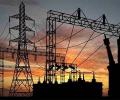
India's industrial production rose by 7.1 per cent in November 2022 after contracting in October, according to official data released on Thursday. The Index of Industrial Production (IIP) grew by 1 per cent in November 2021.

In terms of industries, 22 out of 23 industry groups in the manufacturing sector showed positive growth during July 2018.

RIL and its partners BP plc of UK and Canada's Niko Resources have spud the seventh well on the MA oil and gas field in the KG-DWN-98/3 or KG-D6 block in Krishna Godavari basin.
MSMEs contribute immensely to the industrial landscape of the country in terms of their 45 per cent share of manufacturing output and 40 per cent of exports.

India will not tailor its policies to suit US EV maker Tesla, and its laws and tariff rules will be formulated to attract all-electric vehicle manufacturers from across the world to set up a base in the world's fastest-growing economy, Commerce and Industry Minister Piyush Goyal said. Tesla has been seeking an initial tariff concession that would allow it to offset 70 per cent customs duty for cars priced less than $40,000, and 100 per cent for cars of higher value.

In the manufacturing sector, output is expected to decline by about 70 per cent as only food-processing, and drugs and pharma industries are allowed to operate while other segments, such as engineering and metals, have shut operations.
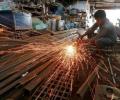
Reflecting a loss of "growth momentum", manufacturing activities in the country slowed down to a six-month low in March amid softer increases in new orders, production and employment, according to a survey.

The production in Maharashtra is pegged higher at 11-11.5 million tonnes against 10.71 million tonnes

The two-wheeler segment has shown signs of recovery in the first half (H1) of calendar year (CY) 2024, largely driven by improving performance in rural areas. According to the Federation of Automobile Dealers Associations, rural contribution to two-wheeler sales surged by 57-60 per cent in the April-June quarter of 2024-25, indicating a rising demand in these regions. Experts believe that this trend will continue, supported by a favourable monsoon season and government initiatives aimed at rural development.

India's economy grew 7.6 per cent in the September quarter of this fiscal and remained the fastest-growing large economy, mainly due to better performance by manufacturing, mining and services sectors, the government data showed on Thursday. The gross domestic product (GDP) expanded by 6.2 per cent in the July-September quarter of 2022-23. India remained the fastest-growing major economy, as China posted a 4.9 per cent growth in July-September 2023.

Petitioning the RBI to slash key interest rates, India Inc on Thursday said the recovery in industrial production in November must be seen with "caution" as the performance of critical sectors like capital goods remains poor.
The country's industrial production has risen by 11.4 per cent in September 2006 over the year-ago month, powered by double-digit growth in manufacturing and electricity sectors.\n
India's services sector activities eased in March as growth was hit by the detrimental impact of the coronavirus pandemic and input costs remained elevated, a monthly survey said on Wednesday. The seasonally-adjusted India Services Business Activity Index fell from 55.3 in February to 54.6 in March. Though the rates of expansion softened, it indicated growth for the sixth consecutive month. In PMI parlance, a print above 50 means expansion while a score below 50 denotes contraction.
